
Interview with David E. Kelley and Eva Anderson: Behind The Scenes of Apple TV’s “Margo’s Got Money Troubles”

In a comprehensive conversation about writing for television, David E. Kelley, the creator of Apple TV’s comedy series, Margo’s Got Money Troubles, and executive producer/ writer Eva Anderson, opened up about adapting the novel by Rufi Thorpe and their collaborative vision for the Apple TV series.
Elle Fanning stars as Margo Millet, an aspiring writer and recent college dropout. She’s the daughter of Shyanne, a former Hooters waitress (Michelle Pfeiffer) and Jinx, ex-pro wrestler and recovering addict (Nick Offerman). She’s forced to make her way with a new baby, a mounting pile of bills, and a dwindling amount of ways to pay them. Until she discovers an artistic way to do it – online, with a webcam.
Avoiding Making Margo’s Got Money Troubles Too Salacious

David E. Kelley. Photo by Andrew Eccles
David: What resonated with me the most from the book was the emotional depth of the characters. That was our core, and that was probably our unconscious leash. We wanted to stay grounded to the emotional truths and take care of the dramatic storylines first, then allow for the humor to come as we went along.
We approached it more as a drama or dramedy than a comedy, so I think that some discipline came in right from the get-go. Being grounded in Margo’s perspective also really helped because she was such a particular character that you didn’t want to exploit, make fun of, or make the joke ever be on her. She’s a smart, interesting person, so everything runs through her. These character elements were in the book.
In a crowded landscape of television where the opportunities to push the envelope are abundant, there’s always a risk of veering into hyperbole. What truly resonated with me about Margo’s Got Money Troubles was the emotional depth embedded within the characters’ journeys. This series is not just about the comedic situations or the outrageous circumstances our characters find themselves in; it’s deeply rooted in their truths.
There’s a scene in Vegas, where Margo and Shyanne are in a heated argument. They’re tackling some seriously painful emotional issues while wrapped in the ridiculousness of bouncing penis headgear.
Margo’s Unique Voice
Eva: Finding Margo’s voice was an intricate process for me. From the very beginning, I understood that Margo is a character whose intelligence doesn’t always align with her life experiences. She’s smart, but she’s not wise.
Margo’s intelligence, and what makes her a dynamic character, is that she’s constantly adapting and changing to her surroundings, but also not letting anything bring her down or destroy her. She uses it all as her superpower. Everything difficult in her life becomes an opportunity in a way.
Margo’s journey throughout the series is one of growth and self-discovery. She responds rather than reacts.
Navigating Hot Button Social Issues Like an Unexpected Pregnancy
David: You didn’t just pay lip service to one issue or the other. It was a character point. We were not trying to make any political or moral statement.
Margo’s decision-making process is rooted in her personal feelings rather than societal pressures. When Margo ultimately articulates her choice about keeping the baby, it doesn’t come from a scientific rationale or an ideological belief. It is, fundamentally, a deeply instinctual choice that reflects her emotions.
It didn’t come from a spiritual, religious, political, or even cognitive place with her mother. She may say or feel that her connection to her father Jinx was an unconscious part of her decision making.
She’s a character who listens to her feelings, and that was the jumping point for the whole series. You’re taking a character who’s going to not just take a dive, but a high dive based on a feeling. What kind of life is that going to begin? What kind of life course is that for a human to charter? That was in the book too.
We wanted to ensure that both Margo’s and Shyanne’s choices were treated with dignity and complexity since Shyanne also faced the same situation.
Margo’s choice to keep the baby coincides with Shyanne’s decision to carry her pregnancy to term. We wanted to present them as multi-faceted individuals making deeply personal decisions, not characters fitting into neatly defined boxes.
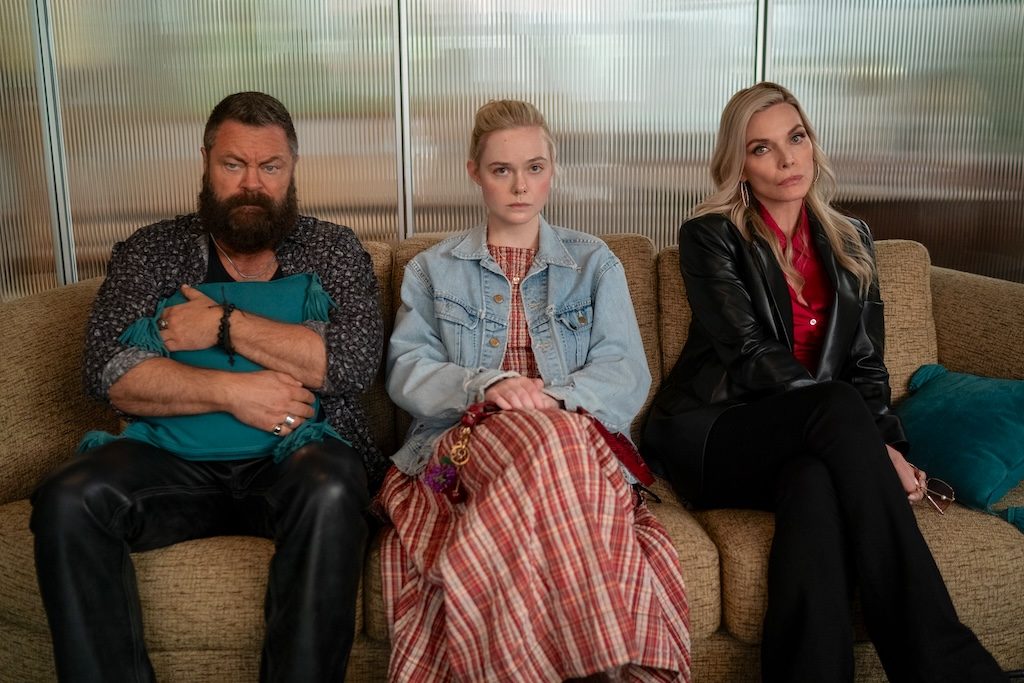
Jinx Millet (Nick Offerman), Margo Millet (Elle Fanning) & Shyanne Millet (Michelle Pfeiffer). Photo courtesy of Apple TV
Mark’s Changing Character
Eva: Mark Gable (Michael Angarano) is Margo’s lecturer and father of her child. He loses his family.
Now that Margo’s sex work is out in the open because she’s been doxed. In the beginning, asking for custody is a noble thing. He’s actually stepping up and saving this kid. I think that comes out in the very first mediation.
He’s both down on his luck and very depressed, but he’s also coming from a place of genuine fear for what he thinks this kid’s future is going to be. Over the course of the next episode, I think that fear curdles into spite. Now he just wants to win because he has gone this far, and he’s mad at Margo. What gets him all the way to court is a mixture of fear and spite, which ultimately blows up in his face.
[More: David E. Kelley Discusses Adapting “Presumed Innocent”]
Adding Comedy To Serious Themes
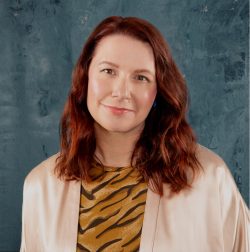
Eva Anderson
David: Humor is carefully woven into the fabric of the narrative rather than existing as an isolated element. We aimed to use humor to highlight the absurdity of certain life situations while ensuring it doesn’t undermine the emotional stakes.
Eva: I think a great example of this can be seen in the overall chemistry between the characters. The humor often stems from their relationships — how they navigate friendship, love, and the complexities that arise within those realms. It’s this interplay that allows the audience to connect with the characters on a deeper level.
David: While our primary focus is on Margo’s personal journey, the underlying themes of connection, self-discovery, and navigating adulthood resonate universally. We delve into the challenges faced by young people today, from unexpected pregnancies to the pressures of navigating relationships in a complex world. These issues are real and relatable, and we hope audiences will find solace and validation in Margo’s story.
Inside The Family Drama
David: Margot articulates that at the end. Looking backwards, you have to live life forwards, but it can only be understood backwards. As Margo is looking at it backwards, she’s seeing all the tear and the nastiness of that fabric being pulled on as a good. Her family members are in each other’s face, but in each other’s hearts, collaterally sometimes.
There are many families that never argue, never fight. They go about their business in their respective lanes and get together over the holidays, but they never infect or get inside each other. This is not such a family.
They gnaw, they pull, and they claw at each other, but the end result is a melding. They’re a loving family. One of the big messages from the book and a North Star for the series is that the cavalry’s not coming to save them. The outside systems that people rely on, are not coming for them.

Join the Discussion!



Browse our Videos for Sale
[woocommerce_products_carousel_all_in_one template="compact.css" all_items="88" show_only="id" products="" ordering="random" categories="115" tags="" show_title="false" show_description="false" allow_shortcodes="false" show_price="false" show_category="false" show_tags="false" show_add_to_cart_button="false" show_more_button="false" show_more_items_button="false" show_featured_image="true" image_source="thumbnail" image_height="100" image_width="100" items_to_show_mobiles="3" items_to_show_tablets="6" items_to_show="6" slide_by="1" margin="0" loop="true" stop_on_hover="true" auto_play="true" auto_play_timeout="1200" auto_play_speed="1600" nav="false" nav_speed="800" dots="false" dots_speed="800" lazy_load="false" mouse_drag="true" mouse_wheel="true" touch_drag="true" easing="linear" auto_height="true"]







You must be logged in to post a comment Login